
Causation
The 'but-for' test
“Where causation is concerned, a grain of wise subjectivity tells us more about the real world than any amount of objectivity.” - Judea Pearl
This article explains the ‘but-for’ test used to establish actual causation, with a focus on its major drawbacks.
Introduction: What is Causation?Causation is the relationship between an act and the consequences it produces.1 Though it is applied in various fields, the assignment of cause-based responsibility is mainly in the law of crimes and torts. It consists of two parts2:
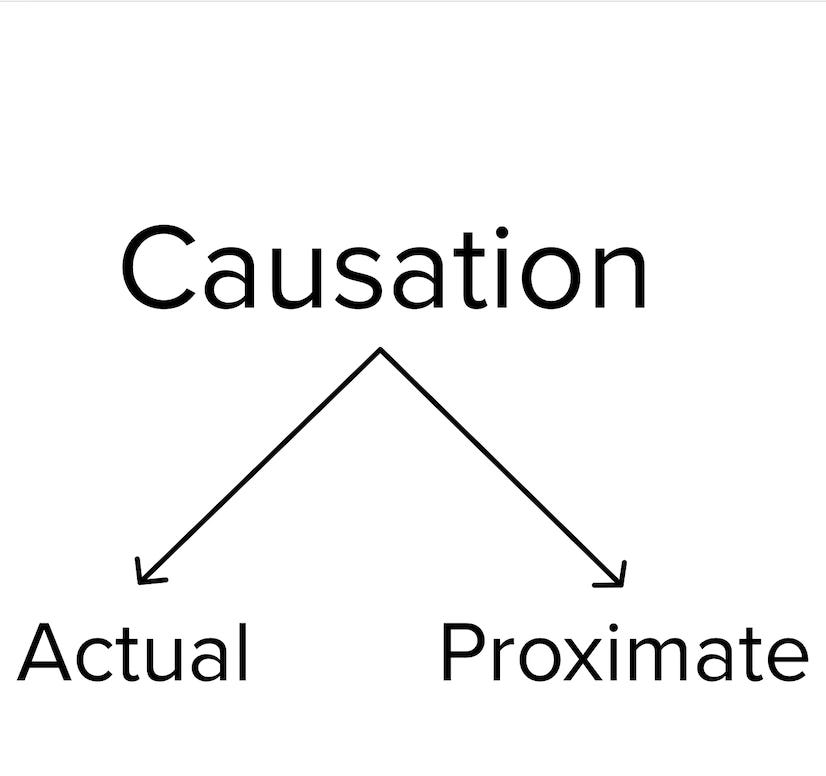
Note the following example:
X, a drunk driver, collides with Y’s car. In a car accident claim, Y needs to prove:
X’s negligent driving caused the collision (actual cause).
X driving whilst drunk made the collision reasonably foreseeable (proximate cause).
Actual cause is an objective question of fact. Professor Robertson states, it is “a matter upon which any layman is quite as competent to sit in judgment as the most experienced court.”3
‘Reasonably foreseeable’ means how likely it was that a person could have anticipated the results of their actions.4 It is well-known that drinking impairs ability and driving is strongly discouraged in such a condition, so X should have foreseen the consequences.
Remember- Actual causation requires an ascertainable connection between the defendant’s act and the plaintiff’s injury.5 Proximate causation is outside the scope of this article, so its nuances will not be discussed further.
Where it is difficult to prove causation, a ‘robust and pragmatic’ approach must be used to avoid plaintiff’s being uncompensated for technical reasons.6 As CV Dam concurs, causation is “an elastic feature which can be stretched and shrunk according to the magnitude of the other requirements.”7
The ‘but-for’ test, discussed in the subsequent section, is the usual method of establishing actual causation.
The ‘but-for’ testFormally known as the sine qua non test (Latin for ‘without which not’), the ‘but-for’ test corresponds with a scientific notion of causation, i.e., cause-and-effect.
The question asked is-
“But for the defendant’s act, would the harm have occurred?”
In civil cases, a court must conclude on the balance of probabilities, that there is at least a 51% chance the defendant’s actions caused the harm.8 Criminal cases have a higher standard of proof, as it must be beyond reasonable doubt.
Advantages of the ‘but-for’ test include, but are not limited to, the following9:
Respected by a judicial system that places great value on precedent and judicial certainty,
Conceptually clear enough to be grasped by fact finders of any level of sophistication, and
In the vast majority of cases, produces results that align with the everyday person’s intuitive sense of justice.
Nevertheless, it has its challenges. Traditional principles don’t always hold water, as detailed below.
Drawbacks and Workarounds This section showcases the ineffectiveness of the ‘but-for’ test, and highlights the other approaches used for an equitable result.
Multiple Sufficient Causation
When two forces acting independently, each capable of causing the harm in question, combine to injure the plaintiff.
Anderson v. Minneapolis, St. Paul & Sault Ste. Marie Railway10:
One of the railway’s engines caused a fire that destroyed the plaintiff’s property. A second fire, of unknown origin and propelled by the wind, simultaneously spread. The railway argued that, even without their negligent conduct, the property would have been destroyed by the second fire.
If the ‘but-for’ test was applied, it would fail and leave the plaintiff remediless— neither fire was a ‘but-for’ cause, as the damage would have been caused by the other one anyway. However, under the ‘substantial factor’ test, so long as each fire was quite substantial, each was a cause of harm, even though neither fire was a necessary condition of the harm. Therefore, the court held that the railway was still liable.
Indeterminate Defendant
When identifying the defendant is difficult or impossible.
Sindell v. Abbott Laboratories11:
The plaintiff developed cancer due to her mother’s use of a drug to prevent miscarriage whilst pregnant. Although the exact manufacturer of the drug could not be identified, the California Supreme Court applied the principle of ‘market share liability’ and held that manufacturers could be liable based on their share of the market for the harmful product.
Even though this principle has been defended as enhancing societal welfare, it remains unique to the United States.12
Omissions
When a failure to act causes the harm.
Think of medical malpractice cases where the doctor failed to diagnose a curable disease and the patient passed away. The family cannot prove that the plaintiff would have definitely lived (as they could have died even with timely treatment), but they can argue loss of chance for a better outcome. The ‘loss of chance’ doctrine compensates when a doctor’s negligence diminishes the plaintiff’s chances of survival or recovery.13
Traditionalists still prefer the all-or-nothing approach of the ‘but-for’ test because, in loss of chance terms, the defendant would almost always be liable for something.14
Cumulative harm
When there is repeated exposure to harmful conditions over time.
Fairchild v. Glenhaven Funeral Services Ltd.15:
Fairchild, a subcontractor, developed lung cancer from exposure to asbestos fibres during various periods of employment with different employers. Unfortunately, the symptoms developed at a point where the cancer could no longer be treated. After his death, his wife continued the negligence claim against his employers.
The but-for test could not be applied logically, as it was impossible to determine the most likely source. Consequently, the ‘material contribution to risk’ test was applied, wherein multiple defendants can be sued for negligence if their actions increase the risk of harm, even if the actual harm was caused by something else.16
Tunnel vision
When causes that are not immediately apparent are ignored.
Example: X swerves while driving and injures Y.
When the ‘but-for’ test is applied, it is easy to condemn X by concluding that the swerving caused the injury; it does not consider whether X swerved to avoid hitting a child or if Y was jaywalking.
This must be countered by focusing on the chain of events, not just the outcome.
Final thoughtThe ‘but-for’ test will remain a mainstay, but it is our duty to work around the drawbacks and maximise its potential.
“Causation.” A Dictionary of Law, Oxford University Press, https://www.oxfordreference.com/display/10.1093/oi/authority.20110803095555965
Moore, Michael, "Causation in the Law", The Stanford Encyclopedia of Philosophy (Spring 2024 Edition), Edward N. Zalta & Uri Nodelman (eds.),https://plato.stanford.edu/entries/causation-law/
Rue, John D. "Returning to the Roots of the Bramble Bush: The But for Test Regains Primacy in Causal Analysis in the American Law Institute's Proposed Restatement (Third) of Torts." Fordham L. Rev. 71 (2002): 2679
“Foreseeability.” Wex, Legal Information Institute, Cornell Law School, https://www.law.cornell.edu/wex/foreseeability
Supra fn3
David, Hillel, W. Paul McCague, and Peter F. Yaniszewski. "Proving causation where the but for test is unworkable." Advoc. Q. 30 (2005): 216.
C V Dam, European Tort Law (2nd, OUP, Oxford 2013) 309
Supra fn1
Supra fn3, p 2722-2723
Anderson v. Minneapolis, St. Paul & Sault Ste. Marie Railway, 179 N.W. 45, 1920 and Supra fn3, p.2688
Sindell v. Abbott Laboratories, 26 Cal. 3d 588 (1980).
Priest, George L. "Market share liability in personal injury and public nuisance litigation: an economic analysis." Supreme Court Economic Review 18.1 (2010): 109-133. https://www.journals.uchicago.edu/doi/full/10.1086/659983
"What Is the ‘Loss of Chance’ Doctrine in Medical Malpractice Cases?" Powers & Santola, LLP. https://powers-santola.com/blog/loss-of-chance/.
Liang Shi Wei, Jeremy, and Low Kee Yang. "Recognising lost chances in tort law." Sing. J. Legal Stud. (2014): 98
Fairchild v. Glenhaven Funeral Services Ltd., (2002) 3 WLR 89. House of Lords
Musonda, Teddy. "A Limitation to the ‘But For’ Test: Can Multiple Parties Be Held Liable Under Negligence Where the Actual Tortfeasor Among Them Is Unknown?" Amulufeblog, 2024, www.amulufeblog.com/2024/04/a-limitation-to-but-for-test-can.html.