
Force Majeure
Strait of Hormuz crisis
Given its repetition in the news, I thought it pertinent to explain the workings of force majeure.
Approximately 11% of global trade passes through the Strait of Hormuz, and due to ongoing geopolitical tensions, most of it has halted. Oil and natural gas prices are surging, and many of us are dealing with the shortages; Gulf countries have declared force majeure on gas exports, but it has also been invoked by truckers and contractors.
So what is it?
FORCE MAJEURE EXPLAINED
The term was used liberally (and not always accurately) during the COVID-19 pandemic.
Force majeure (‘FM’) means ‘superior force’. It applies when an unforeseeable and uncontrollable event makes performance impossible. This includes acts of God (e.g., hurricanes, earthquakes) and human actions, like war or government orders.
Palmer (2022) explains how excusing performances involves the reconciliation of conflicting principles that have been around since the early Roman days:
Pacta sunt servanda
Rebus sic stantibus
The first refers to the sanctity of a contract and translates as ‘agreements must be kept’, while the second acknowledges the extreme burden that unforeseeable and extraordinary change can have on a contractual obligation.1
FM provisions aim to be mindful of the above.
APPLICATION
Jurisdictional approaches differ.
Civil law systems like China have codified statutes that lay down standards on how to use FM, while common law countries such as England let contracting parties decide the terms.
For a contract with no FM clause, the doctrine of impossibility or the doctrine of frustration may apply.2 However, in some civil law countries, a right of FM may be implied.
When evaluating whether FM applies, the following is generally considered:
Would a reasonable person have foreseen the occurrence?3
Could such an event have been avoided/mitigated/overcome?
Did the performance become impossible or merely burdensome?4
Was the notification procedure complied with?
There must be a causal link between the FM event and the inability to perform.
⮕ If the claim is accepted, the invoking party is excused from performing and from civil liability (e.g., paying damages) with regard to any suspension, deferral, or delay.
Termination of the contract is rare, because the circumstances are often temporary in nature—when the supervening event ceases to exist, there is once again an obligation to perform.
⮕ The contract is always scrutinised and relief differs on a case-by-case basis.
Success is highly dependent on the skill of the drafter, particularly if they delineate the events that qualify as FM and the breach to be excused.
CLARIFYING COMMON MISCONCEPTIONS
An unfavourable economic situation alone is not considered FM, but rather, a natural business risk.
According to Perillo (1997):
“It is generally believed that the risk of financial ability to perform is such a basic assumption underlying all contracts that it cannot be excused…”
FM is often conflated with ‘hardship’, even though they constitute separate doctrines.
FM is when the performance is impossible, and hardship is when it becomes excessively burdensome.
War or a pandemic do not automatically amount to FM.
Most courts strictly construe FM, and tribunals rarely enforce it unless the event in question is specifically mentioned.
Experts provide the following tips:
Parties must clearly allocate risks and draft their own FM clauses suited to their relationship. Augenblick et al. (2012) state-
“…the specific contract…will effectively ‘trump’ any relevant governing law…”
Good faith has to be observed in all negotiations, and adequate notice given before declaring FM.
“An event that may seem predictable in retrospect does not necessarily imply that it was foreseeable at the time of contracting.”- Guo et al. (2024)
INTERNATIONAL COMMERCIAL CONTRACTS
FM originated in the French Civil Code and is now a core principle of the new Lex Mercatoria.
Unforeseeable circumstances are part and parcel of international trade, especially in long-term contracts. As there is a lack of uniformity worldwide, the following attempt harmonisation:
UNIDROIT Principles of International Commercial Contracts 2016
United Nations Convention on Contracts for the International Sale of Goods (CISG)
The below summary only describes how FM is viewed, not the detailed requirements or remedies:
UNIDROIT places FM under the chapter of non-performance. Article 7.1.7 provides for an impediment beyond control that could not ‘reasonably’ have been taken into account when concluding the contract, and neither it nor its consequences could be avoided or overcome.
The CISG does not explicitly call it FM, but see the language of the exemption:
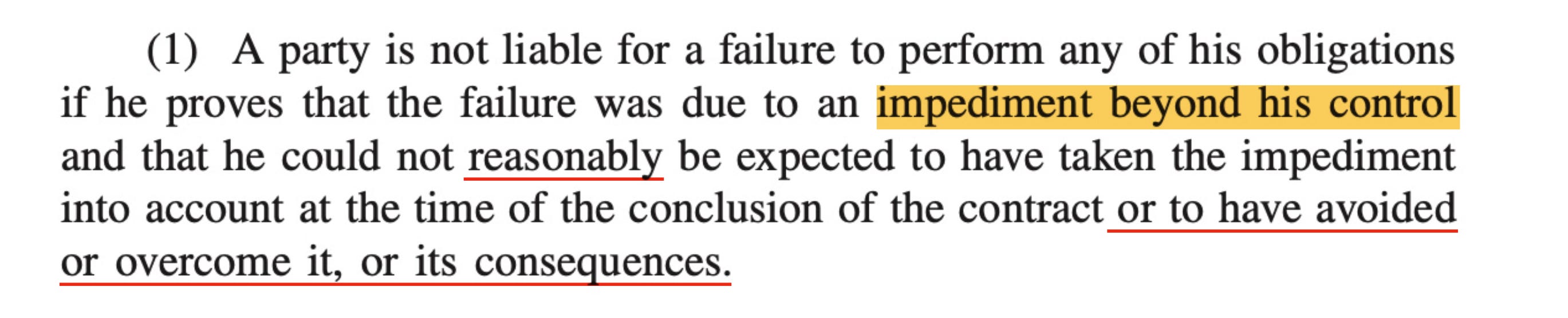
Points to note:
Though the wording is nearly identical, UNIDROIT articulates FM as an excuse for non-performance, while the CISG presents it as an exemption from liability for damages.
UNIDROIT can apply to all commercial contracts, either by interpretation or agreement. Meanwhile, the CISG provides binding standards, but it only covers the sale of goods and not every country is a signatory to it.
Indubitably, both are valuable instruments that help analyse international commercial contracts.
CONCLUDING WORDS
As FM claims surge because of the Strait of Hormuz crisis, lawyers will revisit contracts, suppliers will hope for relief, and tribunals will grapple with difficult assessments.
The public will just wait and watch.
RECOMMENDED READING:
Causation

“Where causation is concerned, a grain of wise subjectivity tells us more about the real world than any amount of objectivity.” - Judea Pearl

Well explained, thank you!
Topical and lucidly explained. Many thanks.